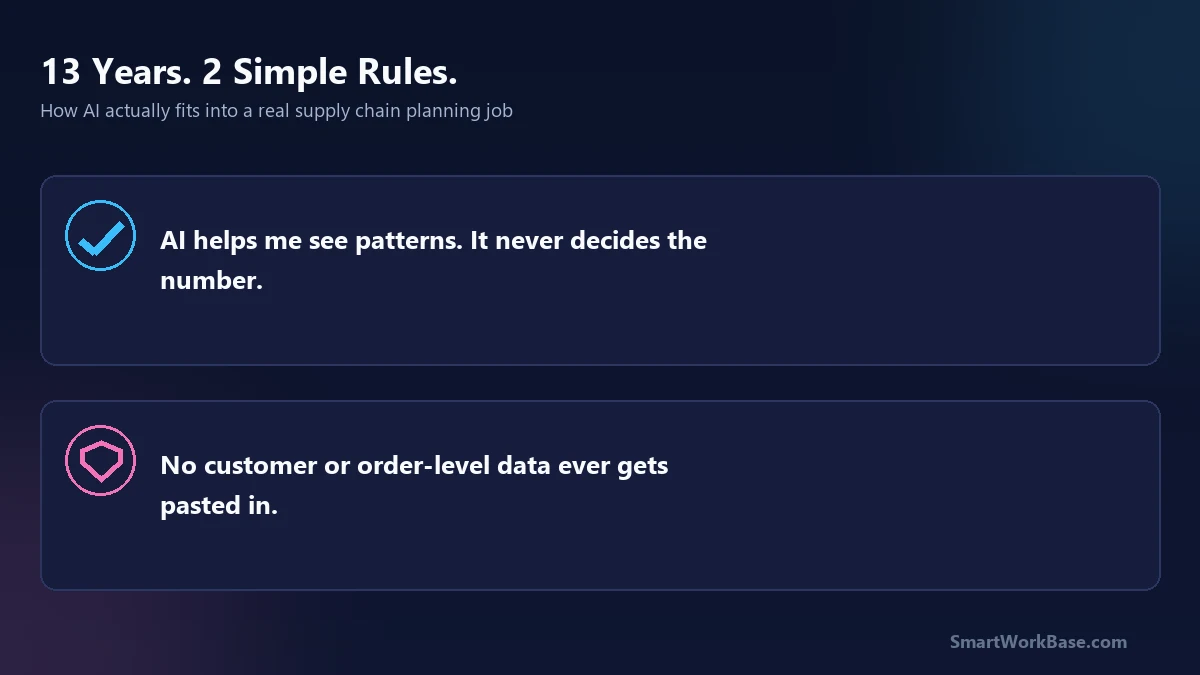
Short answer: yes, but only for spotting patterns in the numbers — never for the actual inventory formulas, and never with real customer or order data. I’ve spent 13 years as a supply chain planner, forecasting demand and tracking actuals at a manufacturing company. Here’s exactly where AI earns its place in that job, and where I keep it out entirely.
Most of what I write on this site is about AI tools for content and productivity. This is the one post about the job that actually pays for the domain — so here’s the honest, unglamorous version of how it fits in.
“Here are the monthly actual demand numbers for [SKU Name] over the past 12–18 months: [paste aggregated numbers]. Before I tell you what I’m looking for, describe what patterns, seasonality, or anomalies you spot in this data. (Aggregated figures only — no customer names or order-level IDs included.)”
Where it actually helps
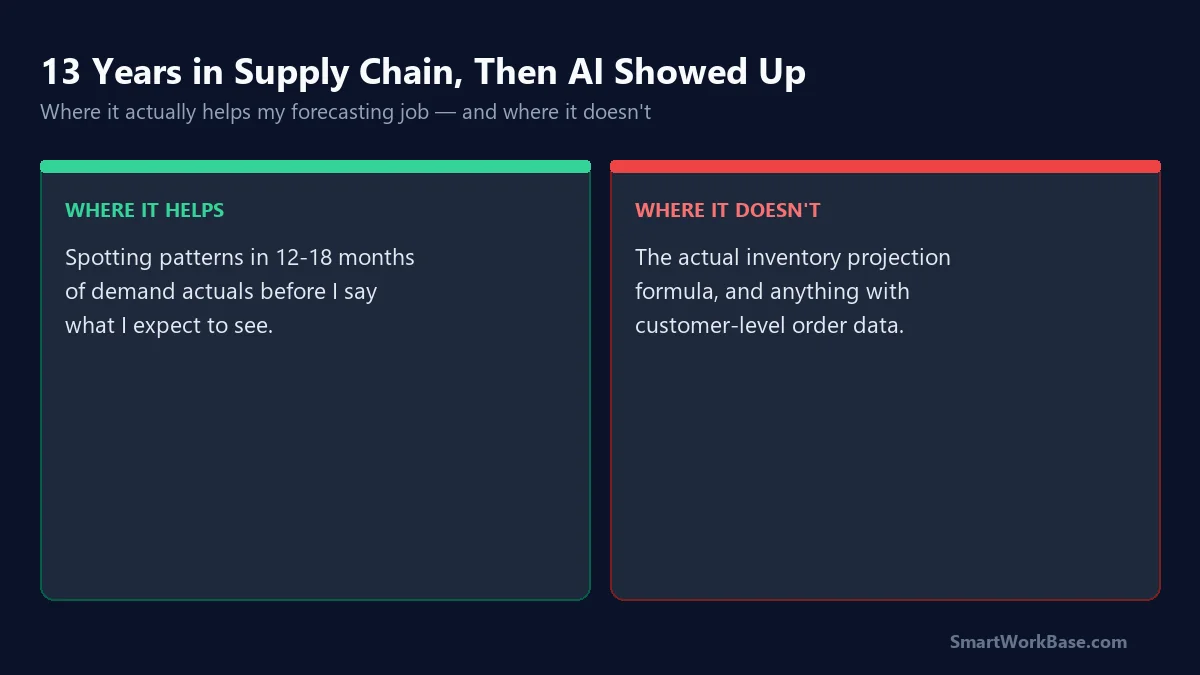
Forecasting has a pattern-recognition problem hiding inside a spreadsheet problem. When I’m looking at a SKU with a weird demand spike — is it a real trend, a one-off bulk order, or noise — I’ll paste the last 12-18 months of actuals into an AI chat tool and ask it to describe what it sees before I say anything about what I expect. Not to make the call for me. To see if it notices something I’ve started to tune out after staring at the same categories for years.
It’s caught things. A seasonality pattern that shifted two months earlier than the year before, which I’d have otherwise attributed to a single large order. It’s also missed things, or flagged noise as signal, often enough that I never skip my own review before it goes into an actual forecast number.
Where I don’t use it at all
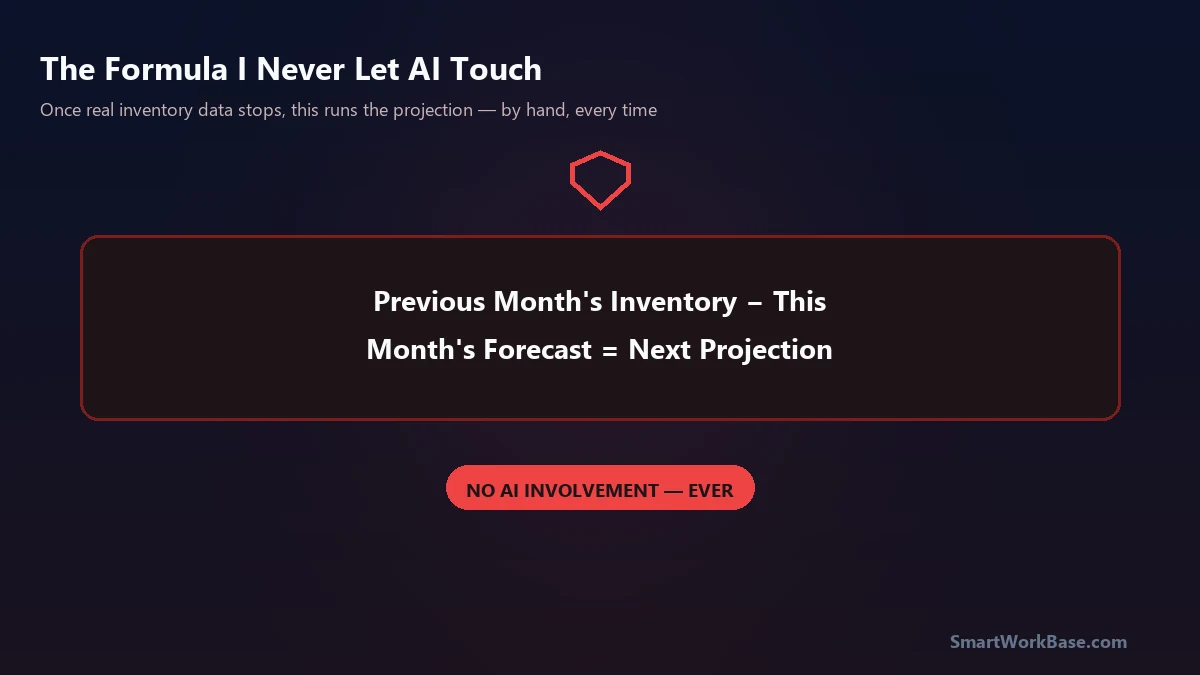
I don’t let it touch the actual inventory projection formulas. Once real measured stock data stops for a SKU, the projection has to roll forward using “previous month’s inventory minus that month’s forecast” — a specific, mechanical calculation that has to be exactly right, every time, because it’s the number that feeds procurement decisions. That’s not a place for an AI tool to “help.” It’s a place for a formula that doesn’t change unless I change it, on purpose, and I know why.
I also don’t use it for anything customer-specific or containing real order data. Wrong tool, wrong risk, for a company system.
What it’s actually saved me
Not dramatic hours-per-week numbers — I’m suspicious of any post, including some of my own on this site, that claims a specific number like that for something this variable. What it’s actually done is cut the time between “something looks off in this SKU” and “I understand roughly why” — from what used to be 20-30 minutes of manually cross-referencing old months, down to a few minutes of a first-pass summary I still have to verify.
That’s a smaller claim than most AI productivity posts make, including the ones I’ve written for this site about AI tools in other categories. But it’s the honest one for this particular job, where the cost of being wrong is a wrong order, not a slightly awkward sentence.