Google just broke the output ceiling. I felt a knot in my stomach.
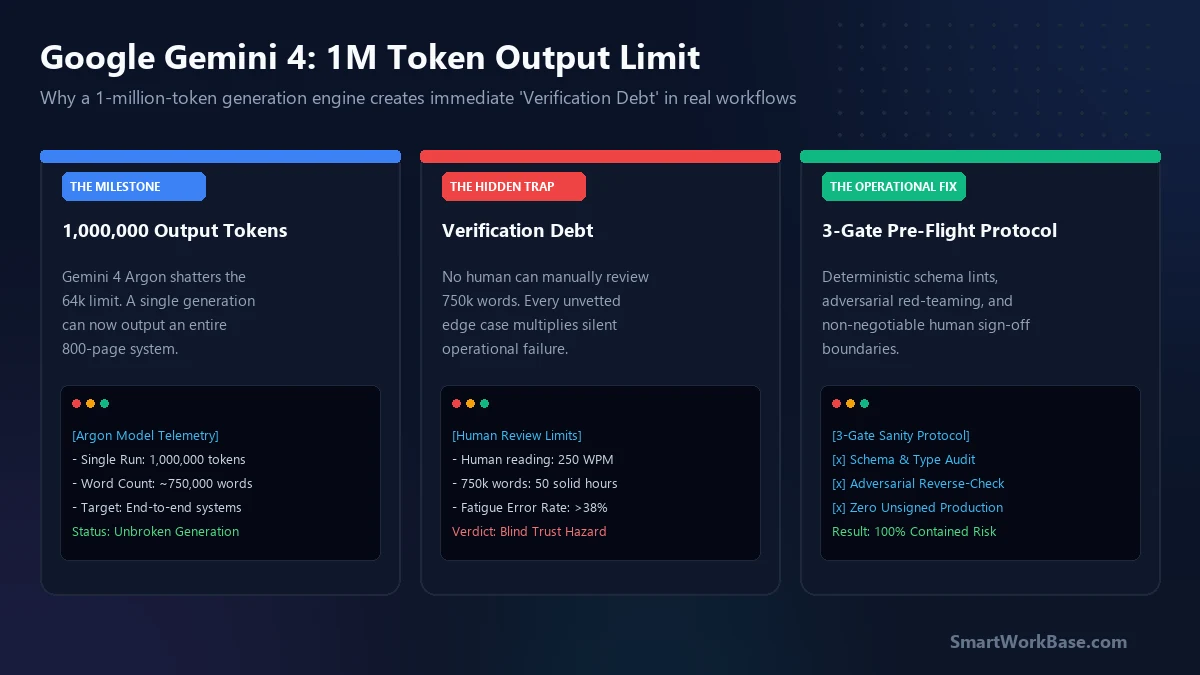
On September 30, 2026, Google announced Gemini 4 Argon. The headline feature is almost absurd: a 1,000,000-token single output limit. For two years, models could swallow massive context windows on input, but output was choked. You got 4,096 tokens. Maybe 8,192. If you pushed the bleeding edge on newer engines, 65,536 tokens. That meant models could draft an essay, refactor a single module, or summarize an earnings report, but they couldn’t generate an entire software repository or a 600-page technical manual without chunking scripts or hitting “Continue.”
Now, they can.
One prompt. One million tokens streamed straight back. That is roughly 750,000 English words. That is War and Peace plus Crime and Punishment combined into a single generation pass.
The tech industry calls this liberation. Planners and engineers who carry operational accountability call it something else.
Verification Debt.
The Math of the Audit Trap
Let’s do the arithmetic nobody wants to run on social media.
An average corporate professional reads analytical prose at approximately 250 words per minute. If you are reviewing legal language, nested formulas, or software routing tables, that speed drops below 150 words per minute. Even if we assume an optimistic 250 WPM, reading 750,000 words requires 3,000 minutes.
Fifty solid hours. More than an entire work week. Staring at raw text.
No human reads fifty hours of technical documentation without severe cognitive degradation. After hour four, your eyes glaze over. After hour eight, your brain spots clean syntax and assumes semantic accuracy. You start skimming. You nod along. You approve.
That is where systems die.
In mid-July, I made a version of this mistake on a much smaller scale. We used Claude 3.5 Sonnet to draft an automated carrier contract annex covering detention terms across seven intermodal depots. The output was only 38,000 tokens—roughly thirty pages of dense logistics legalese. It looked pristine. Clean markdown, elegant sub-clauses, precise headings.
I skimmed it for twenty minutes, verified the top-level liability caps, and forwarded it to our logistics director. Three weeks later, a rail carrier hit us with an undisputed $14,200 demurrage invoice. Deep on page twenty-two, nested inside a clause about weekend gate hours, the model had quietly flipped our contractual grace period from “72 business hours” to “72 calendar hours.”
A single substituted word. Coherent grammar. A five-figure leak.
That was 38k tokens. Now multiply that audit surface by twenty-five.
Why Silent Errors Compound in Long Outputs
When an LLM generates a 300-word email, hallucinations are obvious. If it claims your supplier is based on Mars, you spot it instantly.
In a 500,000-word output, errors are rarely loud. They are structural drifts. A variable name shifts casing on line 4,200. A tariff multiplier quietly changes from 1.05 to 1.15 in table fourteen. A recursive loop lacks an edge-case breakout condition buried 300 pages into an automated architecture file.
Worse, language models suffer from auto-regressive drift. Every token an engine generates becomes the prompt context for the next token. If the model makes a 2% factual wobble at token 15,000, it treats that hallucinated assumption as absolute gospel for the remaining 985,000 tokens. By token 200,000, it is building an immaculate cathedral on top of swamp water.
It looks magnificent. It compiles on the surface. But touch the foundation and the whole thing collapses.
The 3-Gate Long-Output Verification Protocol
If you plan to utilize Gemini 4 or any subsequent million-token generation engine in enterprise operations, you cannot rely on human eyeball review. It is mathematically irresponsible. You must build an automated verification firewall.
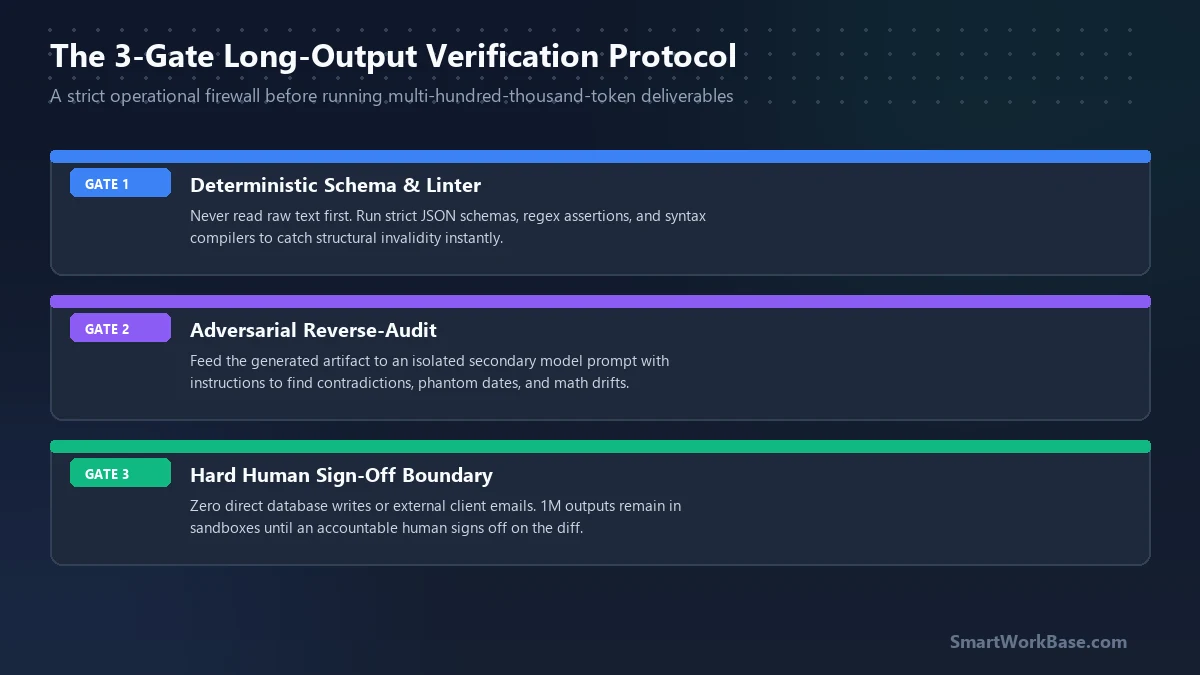
Across our daily workflows, we filter long-horizon outputs through three non-negotiable gates:
Gate 1: The Deterministic Compiler & Schema Lint
Never read raw long output with human eyes first. Feed it straight to cold, dumb, deterministic scripts. If it is code, run it through strict linters, type-checkers (like mypy or TypeScript compilers), and automated AST parsers. If it is data, validate it against strict Pydantic JSON schemas. A script doesn’t get tired. It doesn’t skim. If token 450,000 breaks schema types, the file is immediately trashed and regenerated before a human wastes a single calorie of attention.
Gate 2: Adversarial Reverse-Auditing
Take the generated artifact, slice it into discrete logical modules, and feed it into an isolated secondary model prompt with adversarial instructions: “Find every internal contradiction, unverified numerical assertion, and undefined dependency in this text. Do not summarize. Only output verified flaws.” When you ask an AI to attack another AI’s output, it acts like an overeager junior auditor eager to please. It spots discrepancies human fatigue would breeze right past.
Gate 3: The Sandboxed Human Boundary
No million-token output ever touches production systems directly. It stays inside a quarantine environment. Zero automated database migrations. Zero direct client dispatches. A human planner or developer only reviews the automated diff report generated by Gate 1 and Gate 2. The human’s job is not to read 750,000 words. The human’s job is to adjudicate the forty specific red flags raised by the automated audit tools.
Run this adversarial audit prompt against massive generated documents to catch internal drift and contradiction traps before human review:
You are a hostile technical and compliance auditor reviewing a massive autonomous generation.
Your sole mission is to identify structural failures, not to praise the text.

AUDIT PROTOCOL:
1. Contradiction Check: Identify any paragraph, rule, or formula in the second half of the document that conflicts with constraints established in the first 20%.
2. Ghost Assumption Audit: List every specific numerical figure, external URL, API parameter, or legal deadline that lacks direct grounding in the source prompt.
3. Edge-Case Absence: Flag any section where standard failure recovery (timeouts, null values, demurrage, payment disputes) was omitted in favor of ideal-state assumptions.

OUTPUT FORMAT:
- Severity (CRITICAL / HIGH / MEDIUM)
- Exact Section / Approximate Line
- The Conflict (What was asserted vs. What contradicted it)
- Action: Delete, Rewrite, or Human Escalate.

Do not summarize. Do not provide polite commentary. Output only the error table.
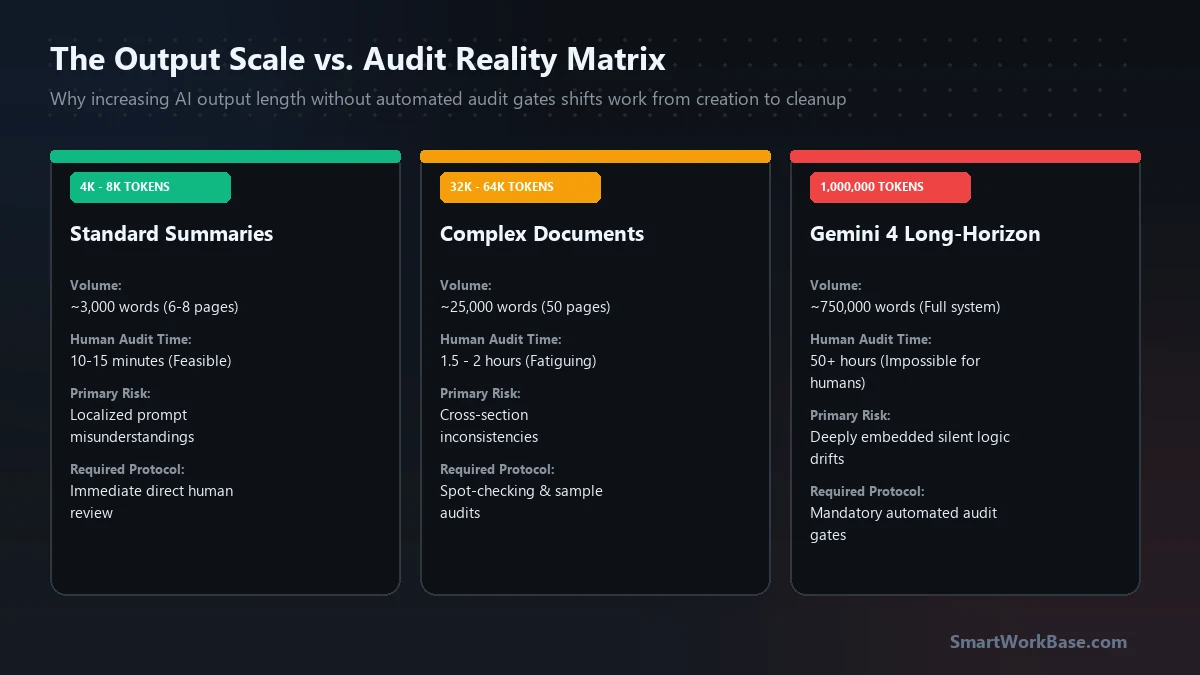
Output Scale vs. Operational Reality
| Generation Scale | Human Review Feasibility | Dominant Risk Vector | Mandatory Safety Gate |
|---|---|---|---|
| 4K – 8K Tokens (Memos, Emails) |
10 to 15 mins (100% Feasible) |
Obvious tone drift or simple factual misses | Direct line-by-line human read |
| 32K – 64K Tokens (50-Page Reports) |
1.5 to 2 hours (Cognitive Fatigue) |
Middle-section hallucinations, forgotten constraints | Targeted spot-checks + automated diff audits |
| 1M Tokens (Gemini 4) (Full Systems, Books) |
50+ hours (Humanly Impossible) |
Compounding auto-regressive drift, silent logic decay | 3-Gate Protocol: Schema linter + Adversarial agent + Quarantine |
Generating text is now essentially free. Verifying text is the most expensive commodity in modern enterprise.
When you celebrate million-token outputs, remember the trade-off. You didn’t eliminate the work. You just traded ten hours of writing for fifty hours of triage.
Field Q&A
Who actually needs a 1-million-token output right now?
Specialized technical environments: massive legacy codebase migration (e.g., converting 400,000 lines of COBOL to Java with full unit tests), generating exhaustive synthetic test data suites, or full-stack autonomous application scaffolding. For standard management memos, weekly executive summaries, or operational reporting, generating 1M tokens is pure reckless waste.
Why can’t I just ask another AI to summarize the 1M output for me?
This is the “Summarization Paradox.” If the 1M-token output contains a silent flaw on page 412, a summarization prompt will almost certainly smooth over the edge case and present a clean, coherent overview. Summaries erase operational friction by design. You don’t need a polite summary; you need an adversarial diff tool that aggressively hunts for fractures.
Does this make junior analysts obsolete or more necessary?
It completely changes their job description. Junior analysts used to spend 70% of their week drafting first passes and 30% reviewing. Now, they will spend 0% of their week drafting and 100% of their week acting as forensic investigators. The highest-paid operational skill of 2026 is no longer prompt crafting—it is knowing where autonomous generations silently rot.