Here is the short answer: I will never let an AI tool touch our Critical Shortage Allocation Matrix. In my previous post on my day job workflow, I explained how I use AI chat tools to spot demand anomalies across historical months. But when component inventory runs dry and five tier-1 customers demand the same 3,500 units, AI optimization is a trap.
Enterprise software vendors love pitching “autonomous supply chain allocation.” They claim an LLM or an algorithmic solver can calculate the optimal split across orders in seconds. In a live manufacturing plant, trusting that recommendation is the fastest way to shut down a customer’s assembly line and lose a ten-year contract.
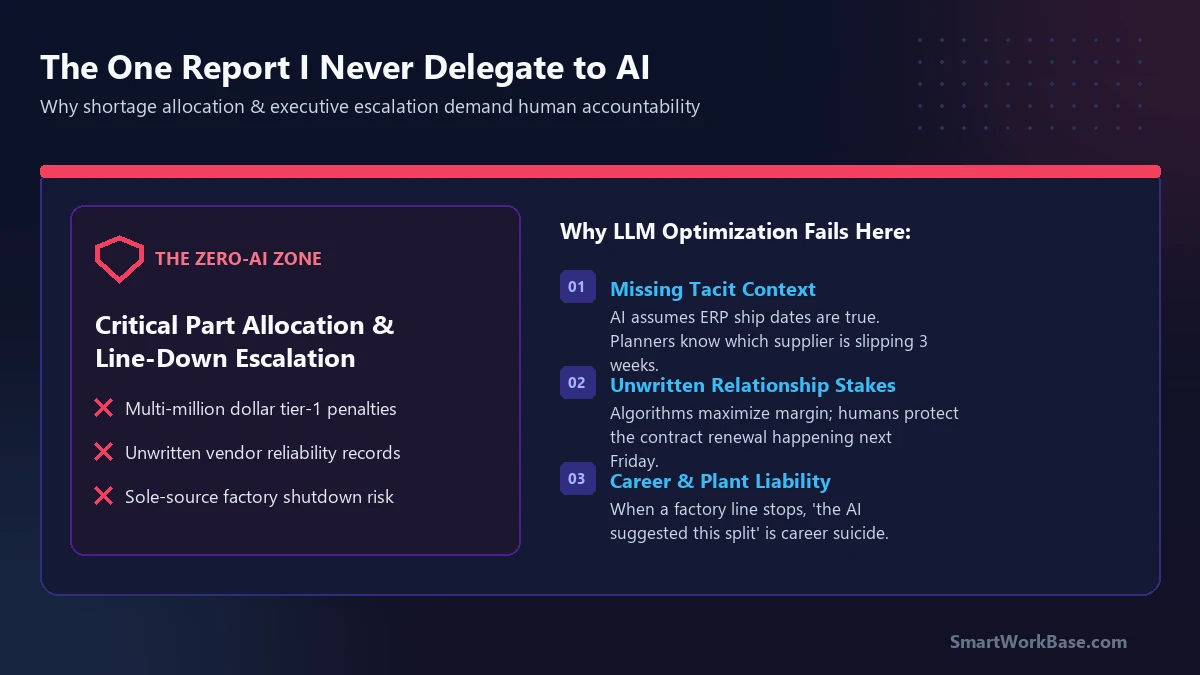
The spreadsheet looks clean, but the plant reality is messy
When you feed shortage data into an AI tool or an optimization script, it does exactly what math dictates. It runs a pro-rata distribution or ranks orders by gross profit margin. On a presentation slide, that looks rational, fair, and efficient.
On the factory floor, that calculation immediately breaks down. Here is what the algorithm cannot see:
- The unwritten contract penalty: Customer A might represent lower margin this week, but their contract includes a $50,000 per-hour line-down penalty starting Friday morning.
- The hidden plant buffer: Customer B claims their inventory is empty, but your account manager knows they quietly hold a three-week safety buffer in their warehouse.
- The supplier trust discount: An ERP system records a component delivery for Thursday. A human planner with 13 years of supplier history knows that vendor has missed every Thursday delivery for six months straight.
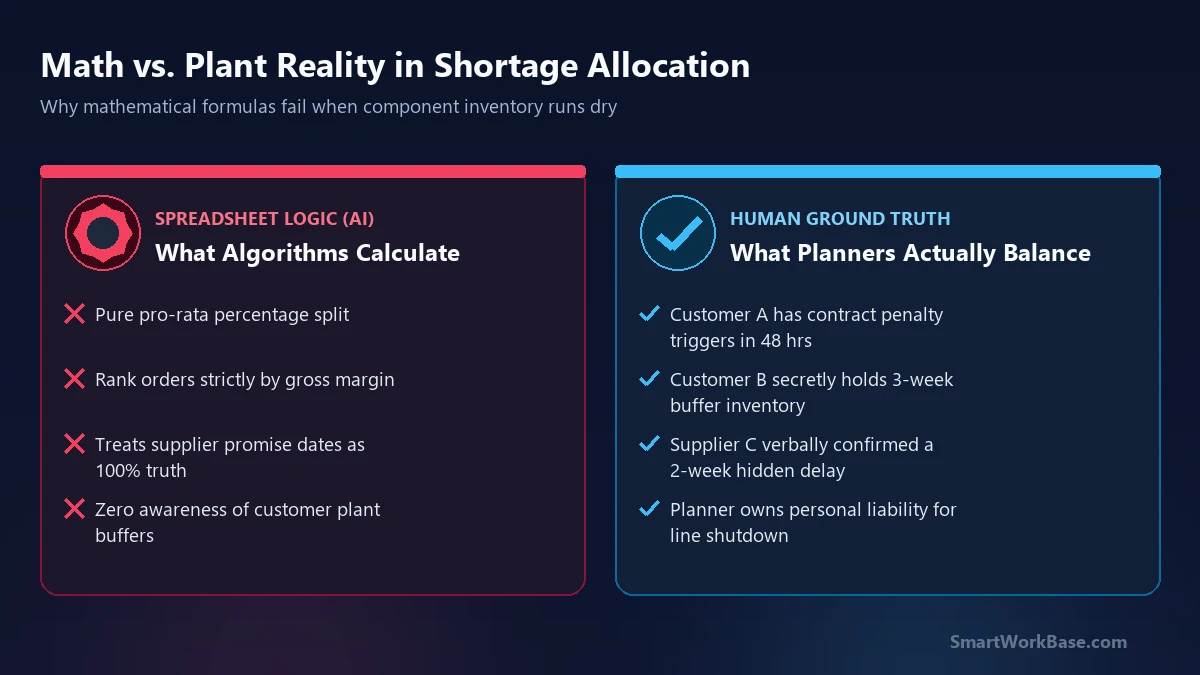
Tacit knowledge cannot be pasted into a prompt window
Every seasoned operations planner operates on tacit knowledge. It is the network of offline phone calls, informal plant updates, and historical relationship nuances that never get typed into an ERP database.
If you attempt to feed all of that context into ChatGPT or Claude, you run headfirst into two serious problems. First, you violate data governance by pasting customer identities, margin structures, and supplier vulnerability details into a third-party chat interface. Second, even if you anonymize the prompt, the model treats qualitative hunches as hard constraints, frequently generating plausible-sounding allocation splits that collapse under executive scrutiny.
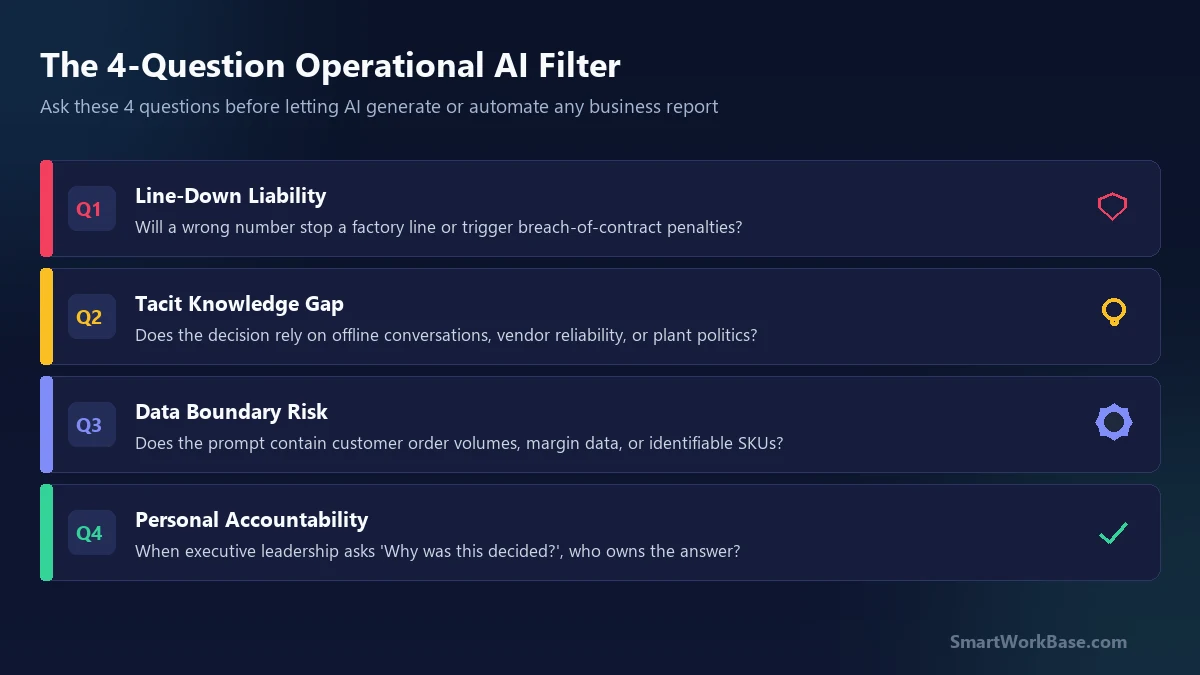
Before delegating any operational report, projection, or summary to an AI workflow, run this quick sanity test:
- Line-Down Risk: If this number is off by 15%, will a physical production line halt or incur legal penalties?
- Tacit Dependency: Does this decision rely on offline vendor track records that don’t exist in the database?
- Data Boundaries: Does the prompt require pasting confidential SKU pricing or identifiable customer order quantities?
- Executive Ownership: When leadership asks why this trade-off was made, can you stand behind it without saying “the AI recommended it”?
Accountability cannot be outsourced to an algorithm
At the end of the day, the biggest reason I keep AI away from critical allocation reports comes down to professional accountability. When an unexpected shortage strikes, trade-offs are painful. Someone will receive less product than they ordered, and someone will have to answer for that decision on a leadership call.
Telling your Vice President of Operations that “the AI suggested allocating 60% to Customer C based on margin optimization” is career suicide. Leadership does not pay planners to execute raw formulas. They pay planners to weigh messy trade-offs, manage customer relationships, and own the consequences of difficult operational calls.
Use AI to draft meeting summaries, analyze historical trends, or find syntax errors in your formulas. If you are trying to figure out which tool fits your current task, check our interactive AI Tool Finder or grab our tested prompts from the Free AI Prompt Cheat Sheet. But when the decision impacts physical supply lines, do the math by hand and own the number yourself.
Frequently Asked Questions (FAQ)
What about specialized enterprise AI supply chain tools (e.g., Kinaxis, Blue Yonder)?
Can AI help draft the customer notification emails during a shortage?
How do you decide which internal reports are safe for AI assistance?
How I Actually Use AI in My Day Job as a Supply Chain Planner →
The first-person workflow: where AI actually earns its place in demand pattern analysis.