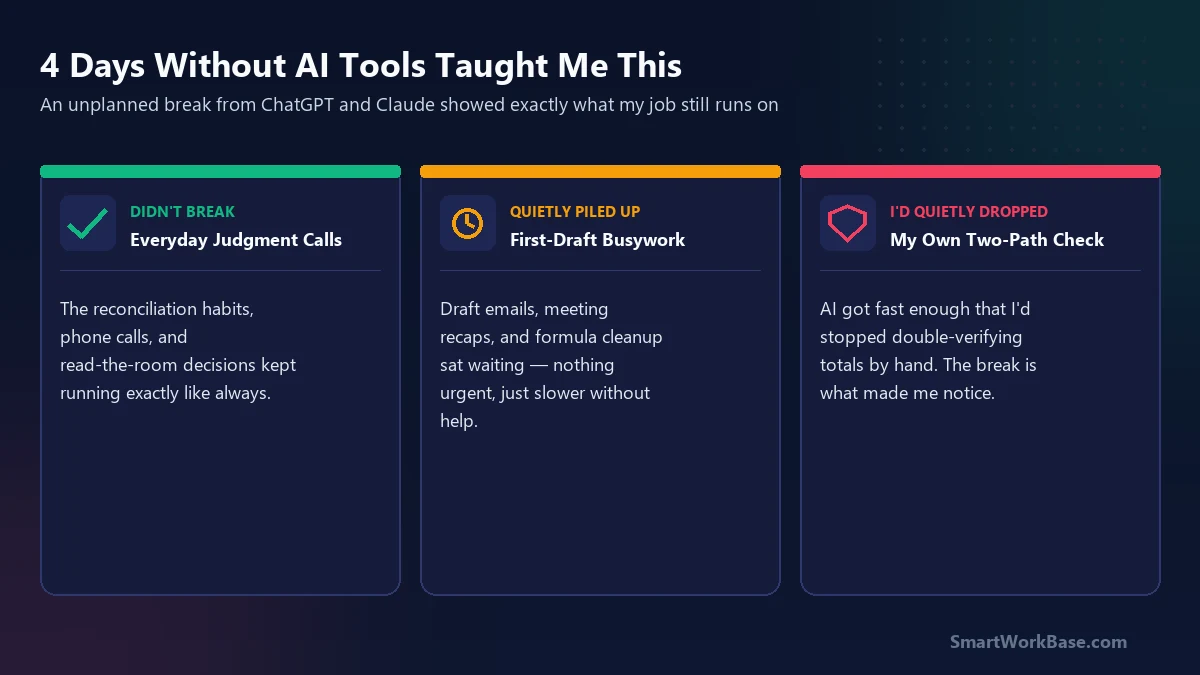
Here’s the short answer: my job survived 4 days with zero AI tools completely fine. The things that depend on judgment — reading a situation, catching an inconsistency, deciding what actually matters in a messy report — never touched AI to begin with, so nothing changed. What piled up was pure busywork: first-draft emails, meeting recaps, formula cleanup. Slower, not blocked.
The more useful discovery wasn’t about AI at all. It was about me. Somewhere in the last few months, I’d quietly stopped running the Two-Path Total Check I wrote about last time — the one habit I said AI couldn’t replace. I hadn’t decided to stop. I just got used to trusting the fast answer.
What I expected to break, and didn’t
Going in, I assumed the 4 days would be rough. Most of my week runs through some AI tool at some point — drafting, summarizing, double-checking a formula.
Instead, the actual decision-making side of my job was untouched. Reading whether a supplier’s excuse for a late shipment sounded credible. Deciding which of three conflicting numbers to trust in a messy handoff. Knowing which meeting comment was the one that actually mattered. None of that ever ran through AI in the first place — it’s judgment built from 13 years of doing the job, and it kept working exactly like always.
What actually piled up
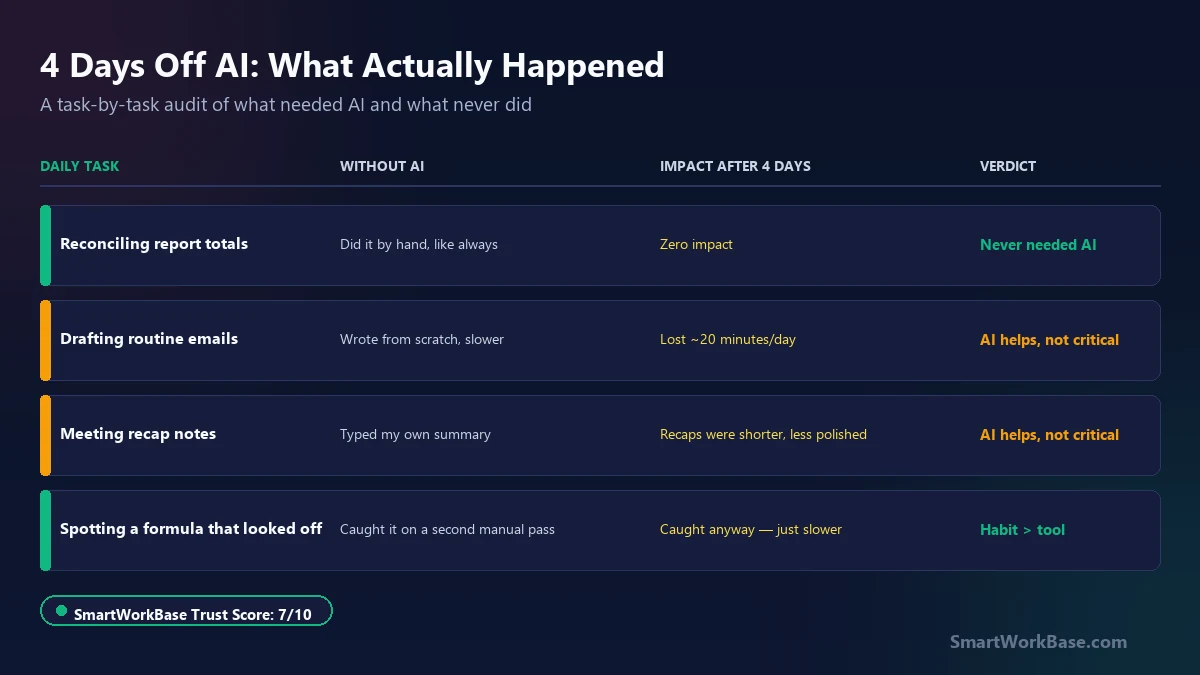
The backlog by day 4 was real, just not urgent. A handful of routine emails I’d normally draft in seconds took longer to write from scratch. Meeting recaps came out shorter and less polished than the ones I usually clean up with a quick pass. A formula I was building for a side report took an extra 20 minutes because I had to look up the syntax myself instead of asking for it.
- Reconciling report totals: did it by hand, exactly like before AI existed. Zero impact — this task never depended on AI.
- Drafting routine emails and recaps: slower and a little rougher, but nothing missed a deadline. AI here is a convenience, not a dependency.
- Catching a formula that looked off: still caught it, just on a second manual pass instead of an instant flag. The habit did the work, not the tool.
The habit I’d quietly dropped
The uncomfortable part came on day 2, when I was reconciling a report by hand and realized I couldn’t remember the last time I’d actually run my own Two-Path Total Check on an AI-written formula. Not because I decided the habit wasn’t worth it anymore — I just got faster at trusting the first answer, one small skip at a time, until skipping it was the default.
That’s the real risk with any AI-assisted routine. It’s rarely a single decision to stop verifying. It’s a slow drift where the tool being reliable most of the time quietly replaces the habit that used to catch it when it wasn’t.
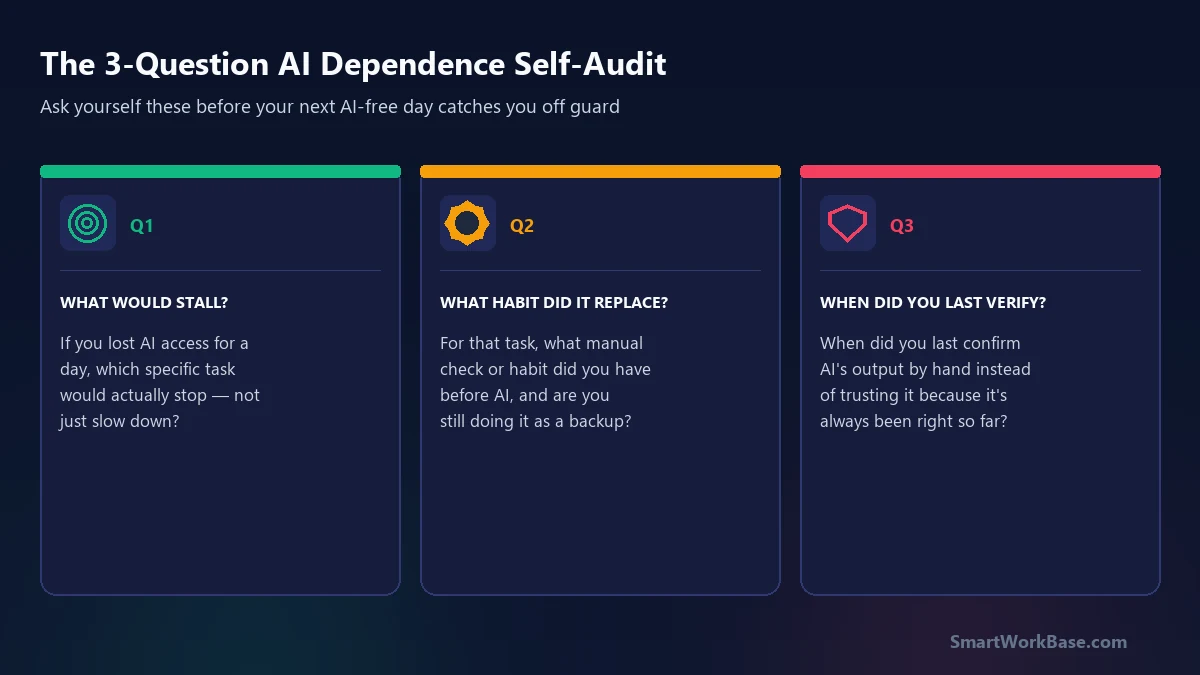
Worth running on yourself before your next AI-free day catches you off guard:
- What would actually stall? Not slow down — stall. Be specific about the one task, not a vague “everything.”
- What habit did AI replace for that task? And are you still doing that habit as a backup, or did it quietly disappear?
- When did you last verify AI’s output by hand, instead of trusting it because it’s been right so far?
What I’m changing going forward
I’m not swearing off AI tools — the busywork savings are real, and I’ll take them back gladly. But I’m putting the Two-Path Check back on a fixed schedule instead of “whenever I remember,” specifically because “whenever I remember” is exactly how it quietly disappeared the first time.
If you want to check your own setup, our AI Tool Finder and Free AI Prompt Cheat Sheet are both built from the same real-world testing as this post. But the one thing worth doing this week isn’t picking a new tool — it’s checking whether one of your own verification habits has quietly gone missing.
Frequently Asked Questions (FAQ)
Was this a planned digital detox, or did something happen?
Doesn’t this contradict your other posts about AI saving hours?
How do I know if I’ve dropped a verification habit without noticing?
The One Excel Habit From My Old Job That AI Still Can’t Replace →
The Two-Path Total Check this post admits I’d quietly stopped running — and why it still matters.