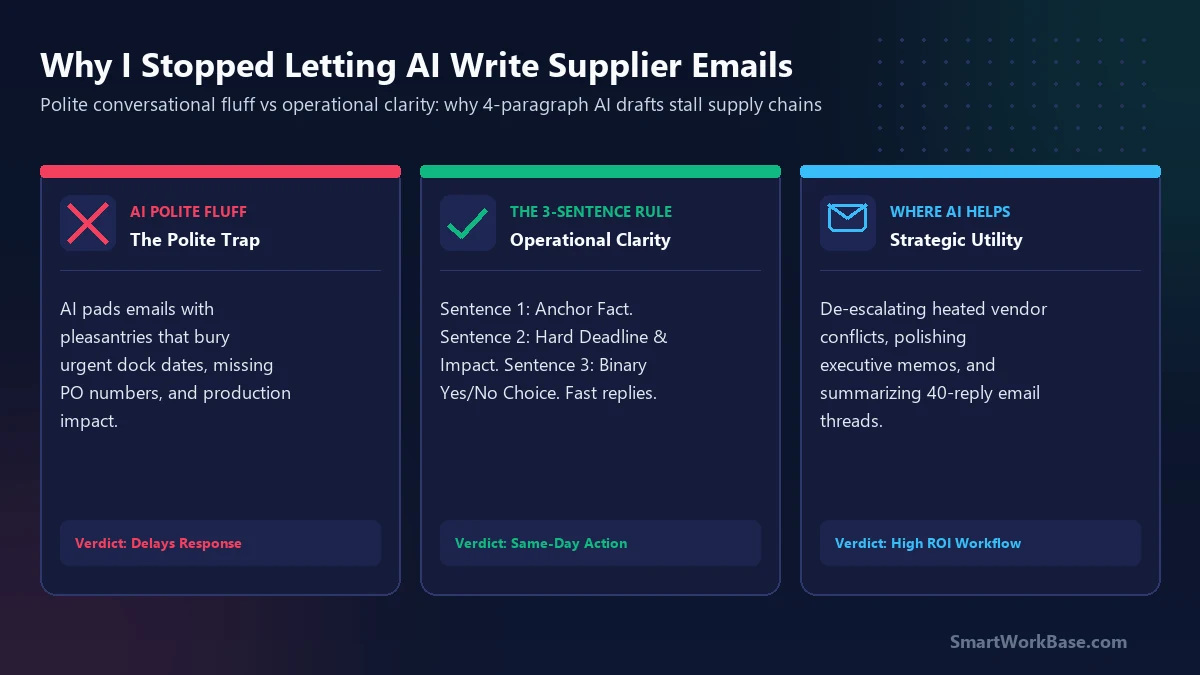
Here is the short answer: when an operational deadline is on the line, politeness is an enemy of clarity. AI tools default to conversational cushioning — “I hope this message finds you well,” “Could you possibly provide an update at your earliest convenience,” and gentle summaries that bury urgency. When a factory scheduler or carrier dispatcher reads that on a phone, they don’t see an emergency. They see a routine inquiry and push it to tomorrow.
I stopped letting AI draft my day-to-day supplier emails after 13 years in supply chain planning taught me a hard lesson: fast responses come from low friction, not high word counts. Today, my operational emails are exactly three sentences long. They take 40 seconds to write, require zero prompt engineering, and get answered within the hour.
The $18,000 resin shipment that taught me
Last year, I had a custom resin shipment for an automated assembly line running behind schedule. The supplier’s production run was split between two facilities, and our plant was three days away from starving the line.
I opened ChatGPT, pasted my bullet points, and asked it to write an urgent but professional follow-up to our account rep. The model produced a flawless four-paragraph email. It opened with warm pleasantries, gracefully acknowledged their production constraints, politely inquired about tracking details, and closed with a gracious offer to discuss alternatives next week.
The rep replied 48 hours later with a generic one-liner: “Thanks Ink, we are looking into this and will keep you posted.” By the time we sorted out the actual dock deadline over the phone, we had to charter an emergency courier flight to avoid shutting down the third shift. That air freight bill was nearly $18,000.
Why AI defaults to conversational traps
Large language models are trained on polite corporate correspondence. When you ask them to write an email, their objective is to sound helpful, diplomatic, and complete. But plant managers, logistics brokers, and warehouse dispatchers receive 200 emails a day. They do not read complete paragraphs.
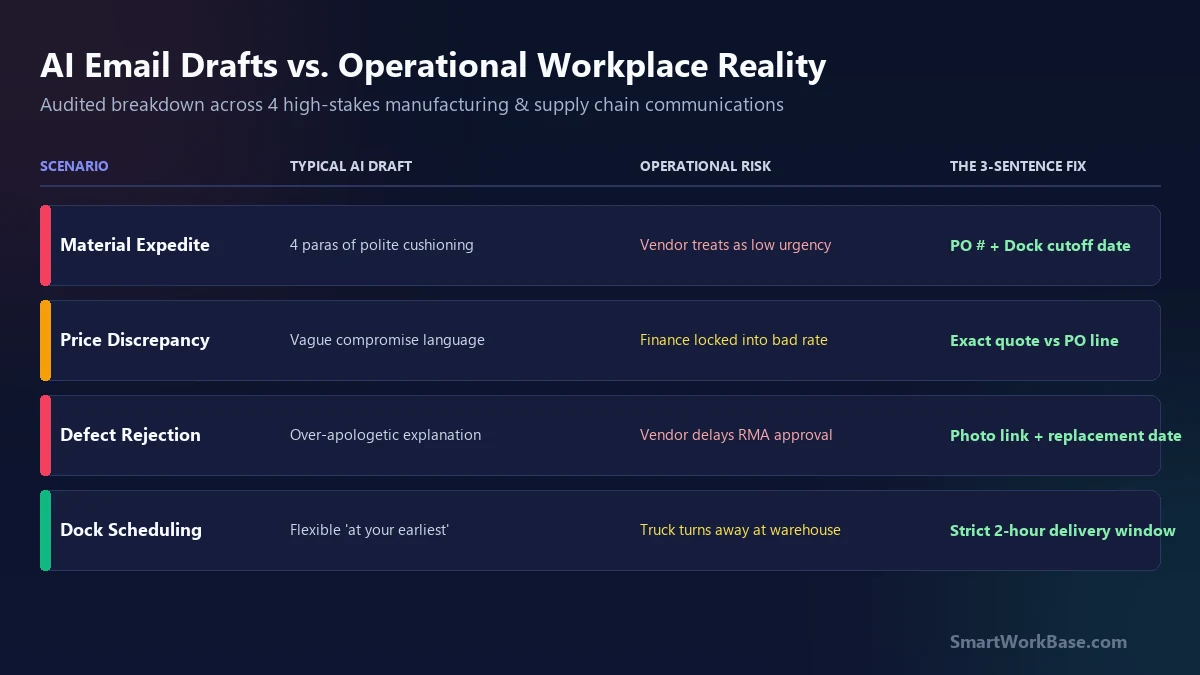
When you feed rough notes into an AI tool, it consistently makes three fatal modifications:
- It buries the identifier: The PO number, line item, and dock arrival time get pushed into the middle of paragraph two instead of the subject line and first sentence.
- It softens hard boundaries: “We must have this by 2 PM or we cancel” becomes “It would be deeply appreciated if delivery could occur around 2 PM to avoid potential schedule adjustments.” The supplier hears an aspiration, not a hard stop.
- It invites discussion instead of action: AI closes with open-ended conversational invitations (“Let me know your thoughts”) rather than a binary operational choice (“Can you confirm dispatch by 3 PM, or should we route our own truck?”).
The 3-Sentence Rule: anatomy of an operational note
The system I use now is strictly constrained. It works whether you are writing in your native language or managing international suppliers as a non-native English speaker — something I explored when reviewing AI writing tools for non-native professionals.
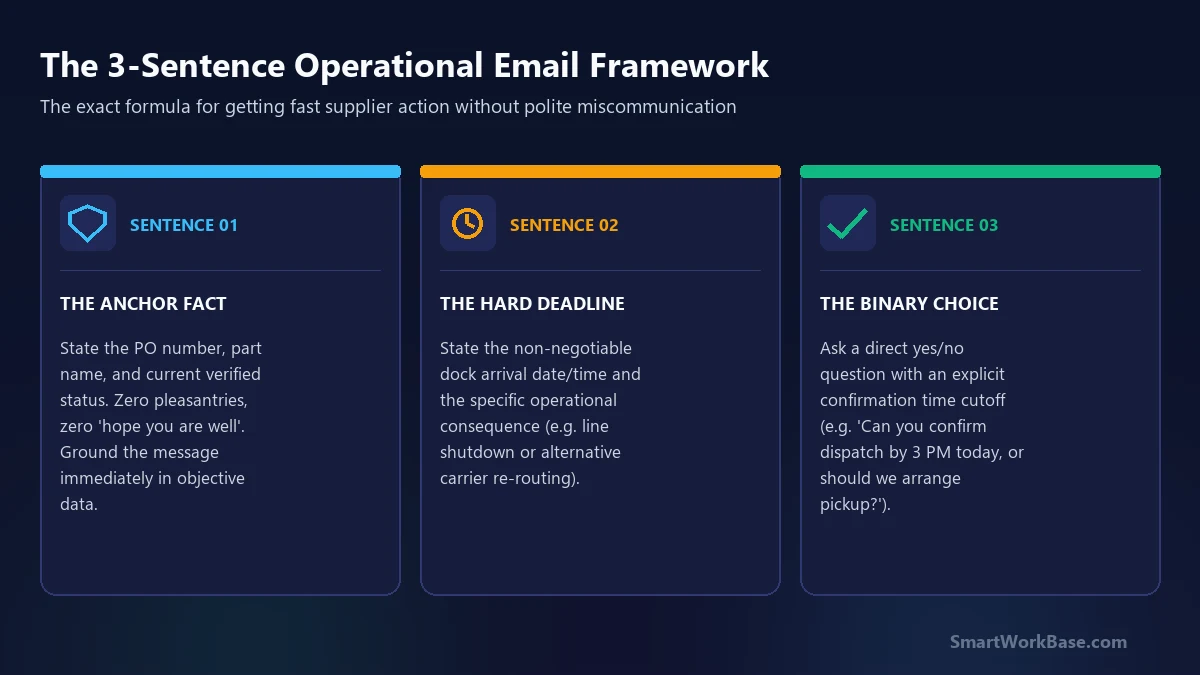
Every operational email follows a strict 1-2-3 structure:
- Sentence 1 (The Anchor Fact): State the PO number, part code, and verified current status. No greetings beyond the recipient’s first name. No “hope all is well.” Just objective data.
- Sentence 2 (The Operational Impact): State the hard dock delivery deadline and the exact operational consequence if it is missed.
- Sentence 3 (The Binary Choice): Give them a clear yes/no decision with an explicit timestamp cutoff for confirmation.
Here is what that looks like in practice:
Subject: PO 84920 (Part #C-104) — Dock Deadline Sept 12, 10:00 AM
Dave,
PO 84920 for 5,000 units of Part C-104 shows pending pickup at your Chicago dock as of this morning.
These units must arrive at our Nashville warehouse by Friday, Sept 12 at 10:00 AM CST to prevent Line 2 from shutting down.
Can you confirm dispatch on today’s 3:00 PM outbound carrier, or should we schedule our own dedicated truck?
Notice what is missing: no apologies, no passive inquiries, no diplomatic filler. Dave can read that entire message on his smartwatch while walking a warehouse floor and reply with one sentence: “Dispatched on 3 PM truck, BOL attached.” Problem solved in 4 minutes.
The one prompt box I actually keep for difficult emails
I don’t let AI draft urgent supplier requests, but I do use it for one specific email challenge: de-escalating tense disputes when an angry vendor email makes me want to write a heated reply.
When emotions run high or contractual terms are disputed, human planners tend to write defensive essays. That is where AI excels — not at adding fluff, but at stripping away hostility and isolating objective facts.
Copy and paste this into Claude or ChatGPT when you have a messy 30-message email thread or an angry vendor inquiry:
Where AI still belongs in my communication stack
As I documented in my piece on how I actually use AI in my day job as a planner and our recent test of working 4 days without touching AI, the goal is never to reject technology. It is about understanding which side of the work creates risk.
Here is where AI still handles email tasks on my desk:
- Summarizing 40-reply vendor threads: Pasting a tangled back-and-forth between logistics, quality, and shipping to extract who currently owns the ball.
- Translating complex technical specs: Checking vendor engineering change notes (ECNs) against standard ISO terminology.
- Checking grammar on formal corporate announcements: When drafting plant-wide policy updates or executive stakeholder reviews.
If you are exploring where tools belong across your daily workflow, take a look at our AI Tool Finder and download our Free AI Prompt Cheat Sheet for verified prompt templates. But when parts are on a truck and a factory line is counting down the hours, leave ChatGPT closed. Put the PO number in the subject line, write three clear sentences, and give the supplier a binary choice.