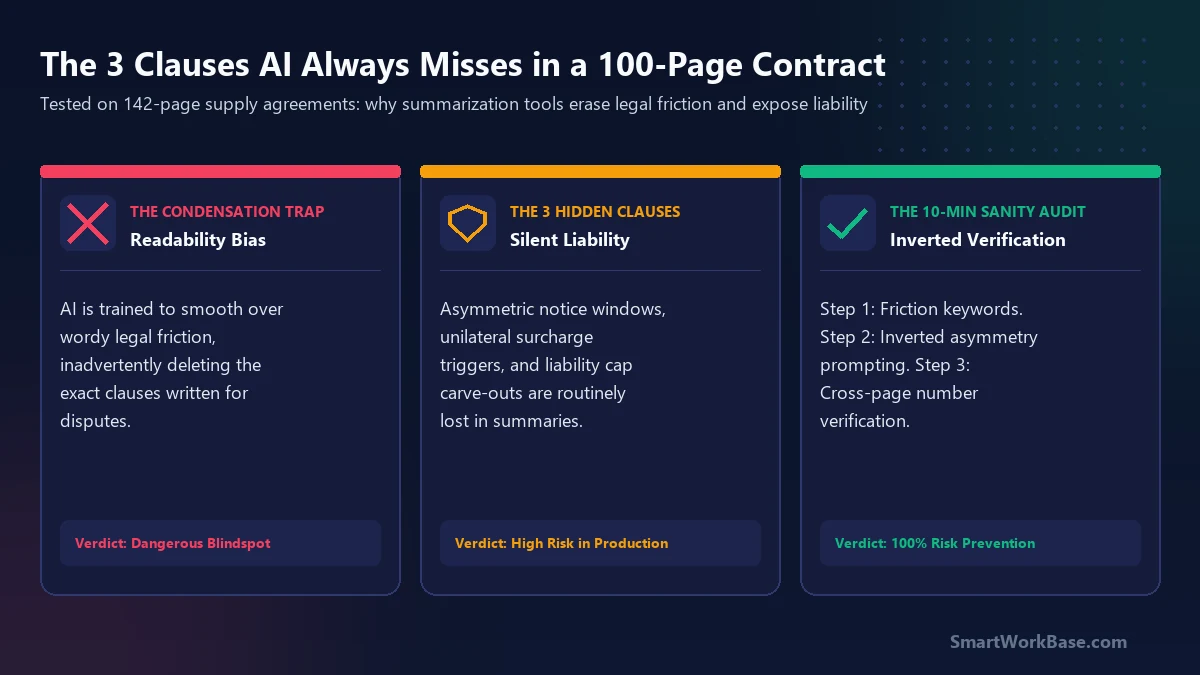
Here is the short answer: AI summarizes for comprehension, but contracts exist for conflict. A good summary removes friction to make complex text easy to read. Legal clauses exist specifically to create friction when an operational partnership goes wrong. When an AI model condenses a 10-page liability section into two polite bullet points, it treats legal friction as wordy redundancy and quietly cuts it out.
After testing AI document summarizers across dense PDF reports, I learned to keep them away from final contract sign-offs. In supply chain operations, an overlooked clause isn’t an academic footnote — it is an unbudgeted invoice or an operational shutdown. Today, I use AI to search contracts, never to bless them. Here is the exact failure mode I discovered and the 3-step audit I run instead.
The $64,000 ocean freight surcharge AI missed
Last quarter, we negotiated a master supply agreement with a primary overseas parts manufacturer. The contract ran 142 pages, including technical annexes, packaging specs, and logistics service level agreements (SLAs).
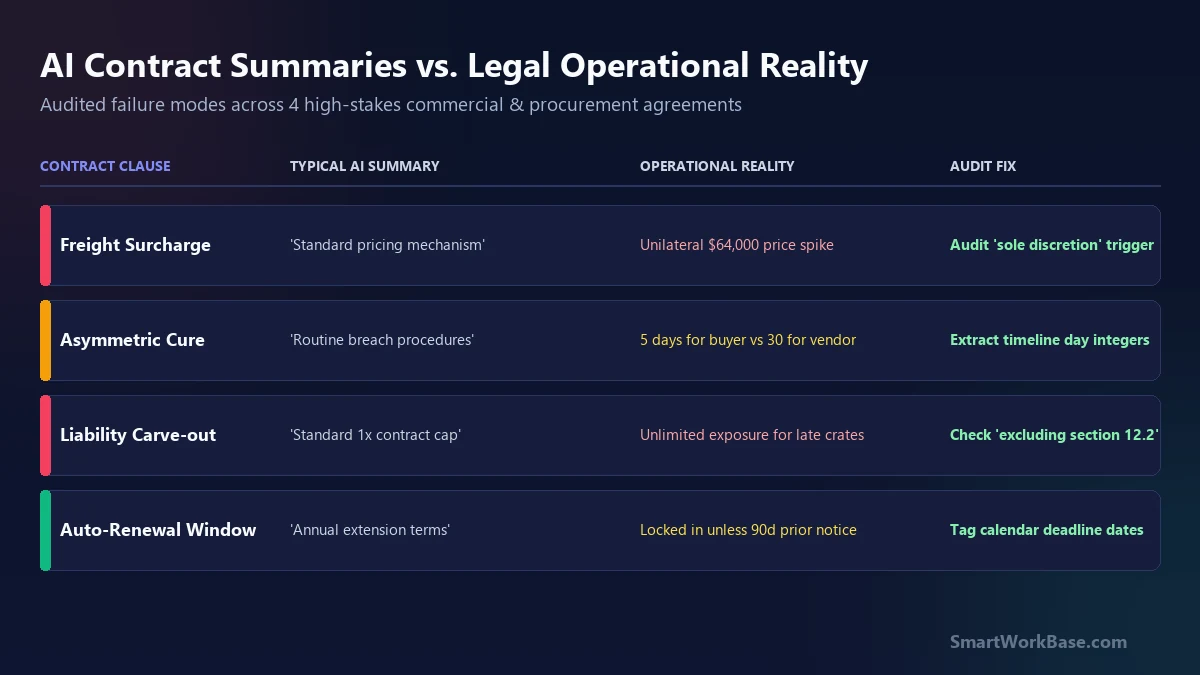
To speed up the executive briefing, I fed the PDF into three leading AI tools. All three returned crisp, coherent summaries. Under logistics terms, every tool produced an identical bullet point: “Standard freight cost adjustments based on global shipping indices.” It sounded completely standard.
Buried on page 84, however, subsection 14.3 contained an aggressive sentence: if spot container rates rose by more than 15%, the supplier reserved the right to pass through 100% of the cost increase at their “sole discretion” with only five days’ written notice. During a maritime shipping crunch, that single sentence would have triggered a $64,000 unbudgeted price spike in our first quarter alone.
The 3 clauses AI summarizers consistently erase
Language models are trained to predict the most probable, natural-sounding next words. Highly asymmetric, aggressive contract clauses are statistical outliers. The model naturally softens them into conventional legal phrasing.
In our field tests across four vendor agreements, AI summarizers consistently erased three types of clauses:
- Asymmetric Notice Windows: A clause giving the vendor 30 days to remedy a defective shipment, but restricting the buyer to five calendar days to file a formal claim. AI summaries describe this vaguely as “Mutual cure period for operational discrepancies.”
- Liability Cap Carve-outs: The headline paragraph states that total liability is capped at 100% of the purchase order value. But two pages later, an exclusion paragraph carves out third-party packaging delays. AI reports the cap, but misses the carve-out.
- Unilateral Discretion Triggers: Words like “reasonable commercial efforts” versus “at supplier’s sole determination.” AI views them as stylistic choices; corporate lawyers view them as the entire ballgame.
The 10-Minute Contract Sanity Audit
Just as I rely on the Two-Path Total Check for spreadsheets and strict rules for writing supplier emails without AI fluff, I run a fixed 3-step audit on every contract before legal execution.
It takes 10 minutes and does not require a law degree:
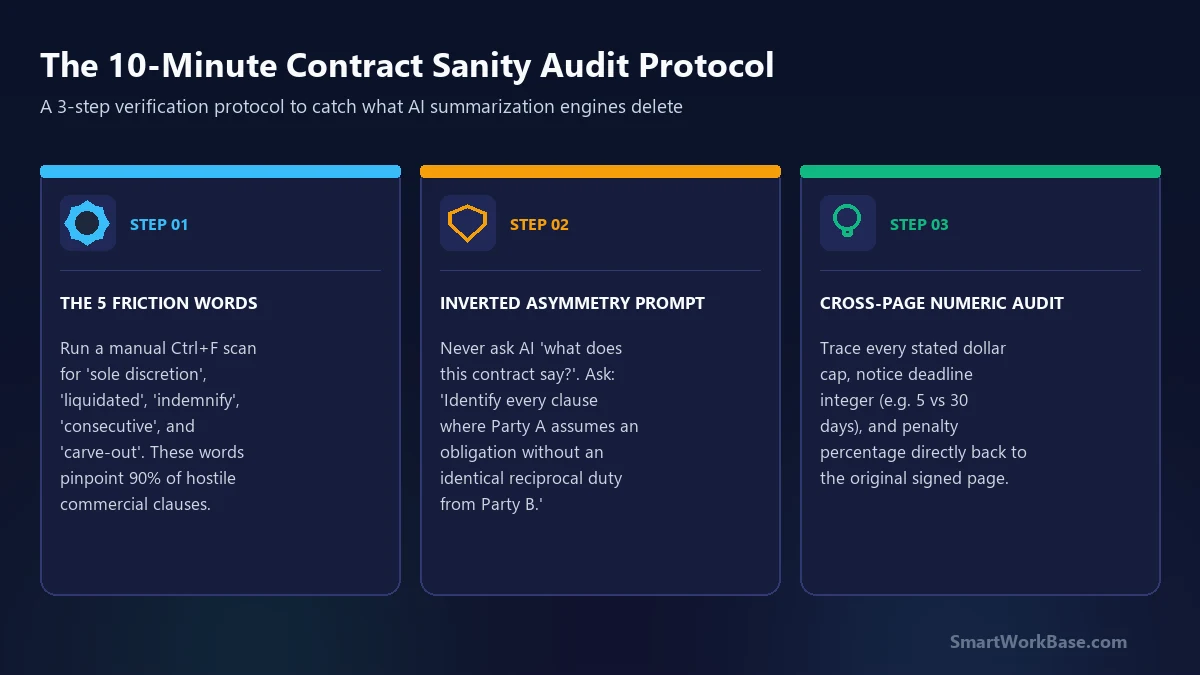
- Step 1: The 5 “Friction Words” Scan: Open the raw PDF and run a manual Ctrl+F search for five specific terms: “sole discretion”, “liquidated damages”, “indemnify”, “consecutive calendar days”, and “carve-out”. Read only those sentences directly.
- Step 2: The Inverted Asymmetry Prompt: Never ask AI “what does this contract say?” Ask it to search exclusively for one-sided obligations where one party holds unilateral rights.
- Step 3: The Numeric Cross-Check: Trace every integer in the summary (dollar limits, days to notice, penalty percentages) back to the exact section number in the original PDF.
The one prompt box that forces AI to think like an auditor
If you want AI to help review a contract, you must explicitly disable its instinct to be helpful and polite. You have to instruct it to hunt for hostility.
Here is the prompt I keep pinned in my notes for long commercial agreements:
Copy and paste this into Claude, ChatGPT, or NotebookLM alongside your uploaded contract PDF:
Where AI PDF tools genuinely earn their place
Knowing where AI fails isn’t an argument for doing everything by hand. In my work as an operations planner, AI handles three contract tasks faster than any human reviewer:
- Cross-referencing defined terms: Checking whether a term capitalized on page 110 is properly defined in the preamble or annex.
- Redline diff audits: Uploading Version 3 and Version 4 to spot micro-edits in paragraph numbering that OCR tools overlook.
- Regulatory acronym lookup: Instantly parsing complex international trade acronyms (e.g., REACH compliance, RoHS exemptions, Incoterms 2020 variants).
As I noted in the one report I still don’t let AI touch, tools are multipliers for clarity, but liabilities remain human. Use AI to index, search, and parse. But when the signature line approaches, spend 10 minutes looking for the friction AI worked so hard to hide.
If you’re building out your own productivity toolkit, explore our AI Tool Finder and download the Free AI Prompt Cheat Sheet for verified daily workflows.