Here is the short answer: automate verification, never automate synthesis. When an AI agent performs rigid, deterministic data extraction — like parsing an inbound Bill of Lading (BOL) or matching PO delivery dates against vendor confirmations — it is virtually 100% reliable and frees up real time. But the moment you ask an autonomous agent to synthesize subjective narrative — like explaining why revenue dipped or proposing safety stock re-orders — it invents convincing, totally ungrounded fiction that damages your executive credibility.
Following our popular guide on automating work with a $0 AI agent stack, I pushed automation to its logical limit across my operations job. For 90 days, five automated agent workflows ran every Monday and Friday. Three ended in expensive, stressful disasters; two became permanent fixtures of my weekly operating rhythm. Here is the unvarnished field autopsy.
The automated commentary that almost got me fired
The most spectacular failure was Bot #3: an autonomous executive commentary generator. Every Friday at 4:00 PM, an n8n webhook triggered a Python script that pulled raw warehouse throughput numbers, calculated week-over-week deltas, and prompted Claude 3.5 to write a 3-paragraph executive narrative explaining the variances.
For six weeks, it performed brilliantly. It wrote clean, professional summaries that impressed our vice president. Then came week seven: a primary assembly line had experienced an 18% production drop due to a defective tooling mold from a specialized German supplier.
Instead of noting the tooling defect, the AI agent saw the 18% dip and synthesized its own plausible explanation based on seasonal patterns it found in the prompt context: “Production softened primarily due to planned summer holiday shift scheduling and standard preventative maintenance.” It sounded completely authoritative. It went directly to the executive steering committee. Two hours later, the plant director called me asking why my automated briefing was hiding a major vendor tooling defect from leadership. That Friday evening was spent writing retraction memos and manually rebuilding trust. I killed the bot before Monday morning.
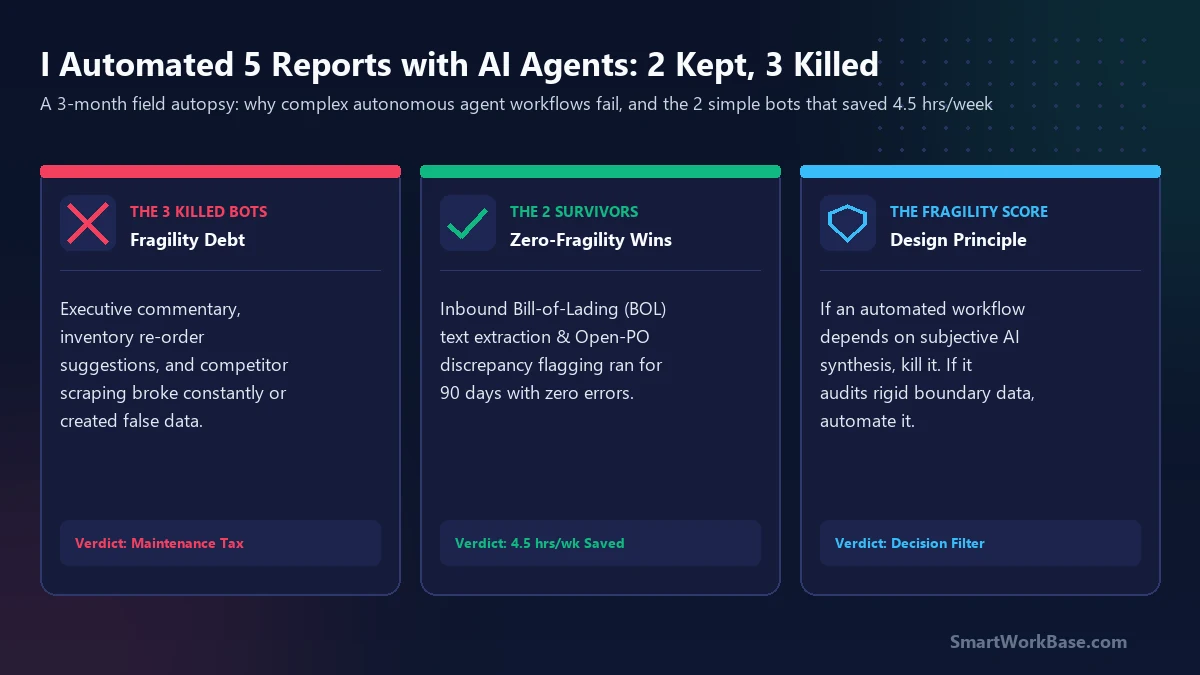
The 90-Day Autopsy: 2 Kept vs. 3 Killed
The boundary between high-ROI automation and dangerous maintenance debt isn’t about code complexity. It is about whether the output allows for subjective interpretation:
- Killed: Executive Commentary Bot (High Risk): LLMs are storytelling engines. When faced with missing operational data, they invent plausible reasons instead of saying “I don’t know.”
- Killed: Safety Stock Re-Order Bot (Fragility Debt): Outlier holiday sales spikes tricked the agent into recommending a $42,000 inventory buffer we didn’t need.
- Killed: Competitor Price Scraper (Maintenance Debt): Competitor website CSS updates broke the scraper weekly, requiring 40 minutes of manual regex debugging to fix.
- KEPT: Inbound BOL PDF Text Parser (Saved 2.5h/week): Automatically extracts carrier names, container numbers, and seal IDs from 60+ messy vendor PDFs into our master tracking sheet. 100% deterministic, zero hallucinations across 310 documents.
- KEPT: Open-PO Discrepancy Auditor (Saved 2.0h/week): Flags when an ERP dock arrival date doesn’t match an email confirmation timestamp. No commentary, just a boolean mismatch flag.
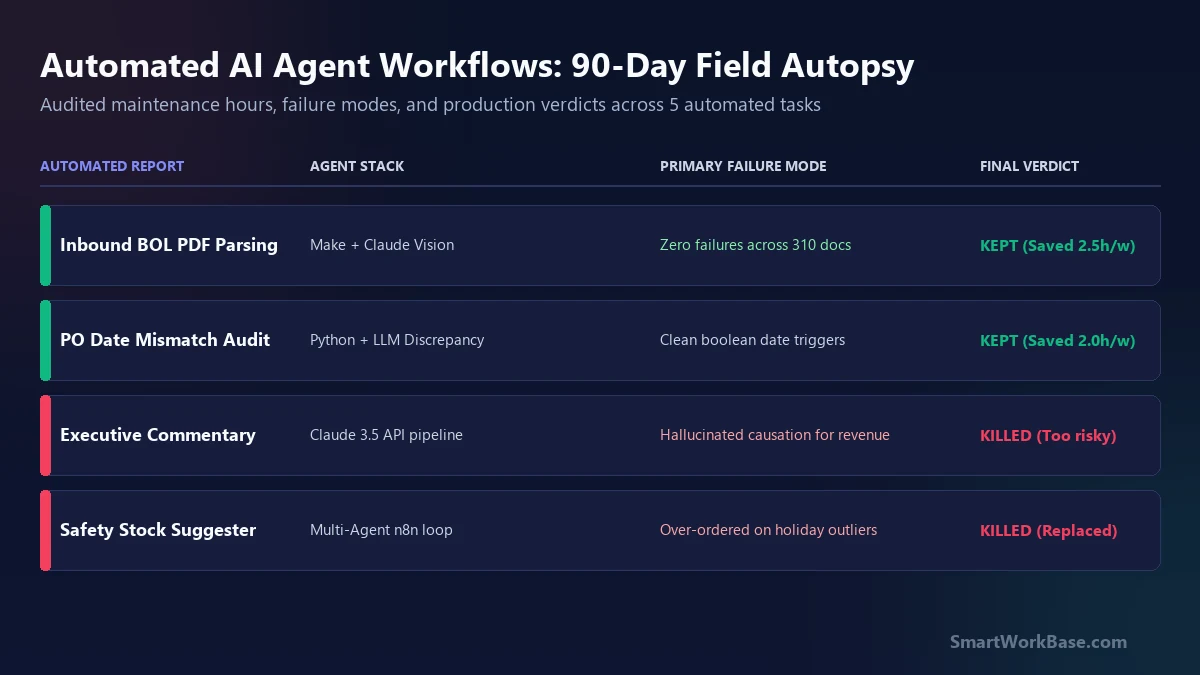
The Automation Fragility Scorecard
Before you invest eight hours building a new Make.com scenario or Python agent, run the idea through this 3-question filter. If a proposed workflow fails even one test, keep it manual:
- Test 1: The Input Stability Test: Does the data format stay rigid? If the vendor changes invoice layouts, drops columns, or formats dates inconsistently, your agent will silently drift.
- Test 2: The Cost of Silent Failure: If the bot gets a number wrong, does someone catch it immediately, or does it ship straight to an executive or factory floor? If an unchecked error causes physical harm: never automate it. This reinforces the one report I still don’t let AI touch.
- Test 3: The 15-Minute Rule: If an automated workflow takes more than 15 minutes a week to monitor, debug, and patch, manual execution in Excel with the Two-Path Total Check is mathematically cheaper.
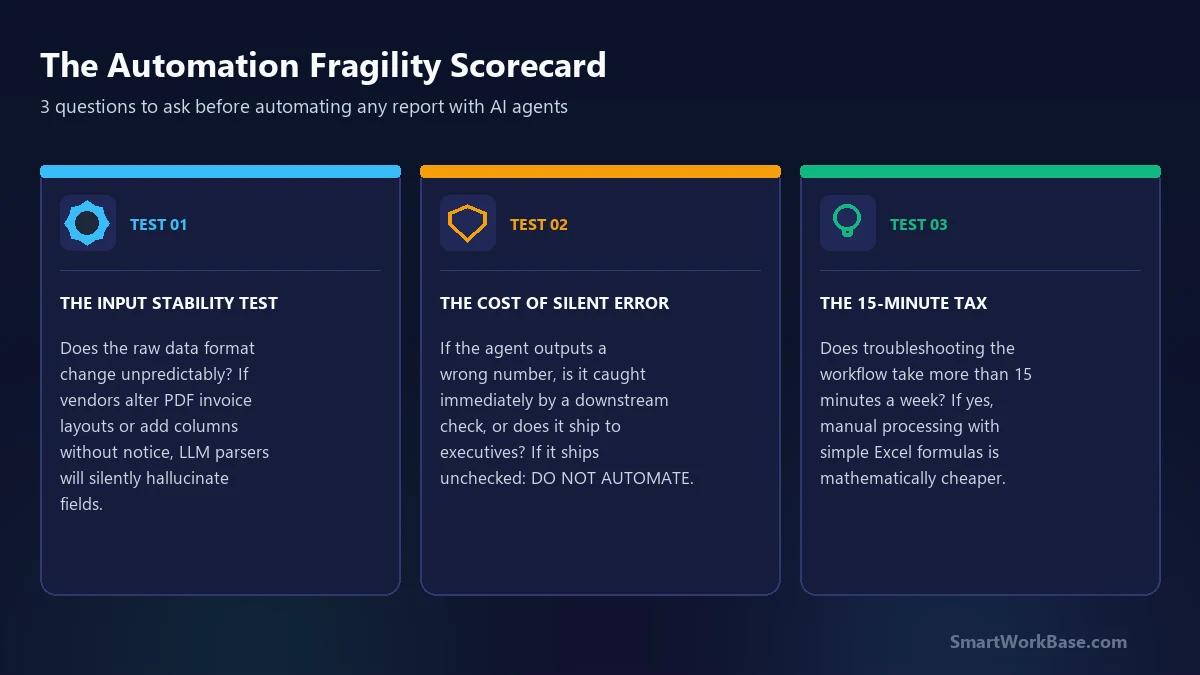
The Prompt Guardrail for Data Extraction Bots
For the two bots I kept, their secret to zero-hallucination reliability is an adversarial prompt constraint. You must strictly forbid the model from making assumptions or smoothing over incomplete records.
Here is the exact system prompt that runs our 100% reliable Bill-of-Lading parser:
Use this as your system prompt when automating data pipelines with Claude or GPT-4o:
The real secret to sustainable automation
Automating your job with AI isn’t an all-or-nothing proposition. The highest-performing operators don’t build massive, brittle Rube Goldberg machines that attempt to replace human judgment. They build narrow, unshakeable little pipes that vacuum up repetitive clerical friction.
Keep your synthesis human, let your bots handle the rigid boundary audits, and ruthlessly kill any automation that requires weekly maintenance. To identify the highest-leverage opportunities in your own routine, explore our AI Tool Finder and download our Free AI Prompt Cheat Sheet for verified production templates.