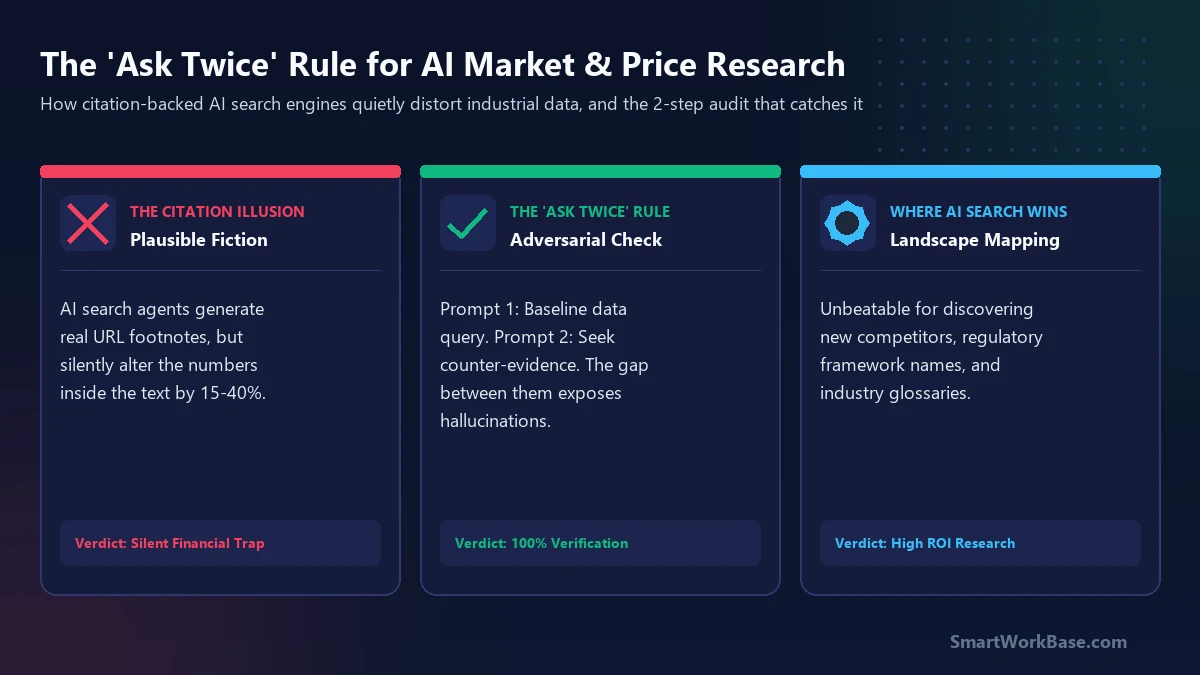
Here is the short answer: a citation link is not proof of accuracy. AI search agents do not copy and paste numbers from web pages; they read a source, compress it into internal token probabilities, and reconstruct the sentence from memory. When you ask for industrial commodity prices, supplier lead times, or tariff effective dates, the model frequently grabs a legitimate source URL but hallucinates the metric — confusing spot rates with contract minimums or mixing up historical averages with current quotes.
Following our earlier audit on how AI research agents replaced 20 open tabs, I started relying heavily on AI search for fast market scans. But speed without verification is expensive. In high-stakes supply chain planning, relying on an unchecked AI market statistic can destroy your bargaining leverage. Here is the exact failure mode I caught and the cross-examination protocol I run today.
The $40/ton resin benchmark that never existed
Three months ago, I was preparing for a quarterly price adjustment meeting with a major polymer packaging supplier. I needed current market benchmarks for industrial-grade polyethylene resin across Southeast Asia.
I opened Perplexity and asked for the prevailing Q2 benchmark price per metric ton. Within seconds, the tool produced a beautiful, highly credible paragraph: “According to recent ICIS and S&P Global commodity updates, regional spot prices stabilized at $1,140/MT, reflecting an 8.4% decrease due to easing container logistics.” It provided three distinct footnote links to industry trade publications.
Confident in the data, I brought that $1,140 figure into pre-negotiation prep. But when I clicked the actual footnote out of curiosity, the referenced article told a completely different story: spot prices were $1,180/MT, and the 8.4% drop was an annual forecast from twelve months earlier. The AI had seamlessly fused two different sentences from opposite paragraphs into one plausible, totally fictitious fact. If I had brought that number into the meeting, the supplier would have immediately known I hadn’t read the primary index.
Why AI search engines hallucinate numbers specifically
Language models are fundamentally optimized for linguistic plausibility, not arithmetic certainty. In market research, this leads to three consistent types of distortion:
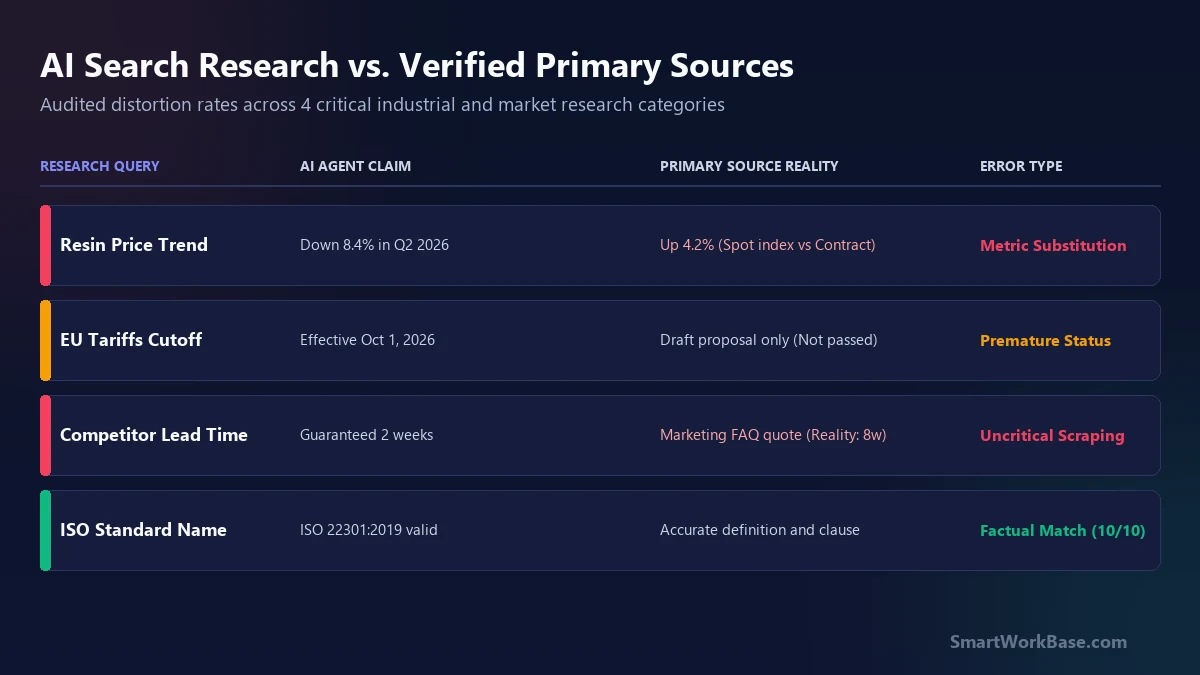
- Metric Substitution: The AI treats similar-sounding terms as interchangeable — presenting spot market prices as annual contract benchmarks, or EBITDA margins as gross margins.
- Temporal Blending: The agent pulls a headline from 2026 and combines it with statistical tables from a 2024 archive without flagging the historical discrepancy.
- Uncritical Marketing Scraping: When searching for vendor capabilities or lead times, the agent scrapes aspirational sales brochures rather than operational SLAs, reporting “instant turnaround” when reality is six weeks.
The “Ask Twice” Rule: adversarial cross-examination
To eliminate these silent errors without going back to manually browsing 30 tabs, I use the “Ask Twice” Rule. It is an adversarial check built on a simple premise: if an AI search agent truly understands a fact, it will defend it against counter-evidence.
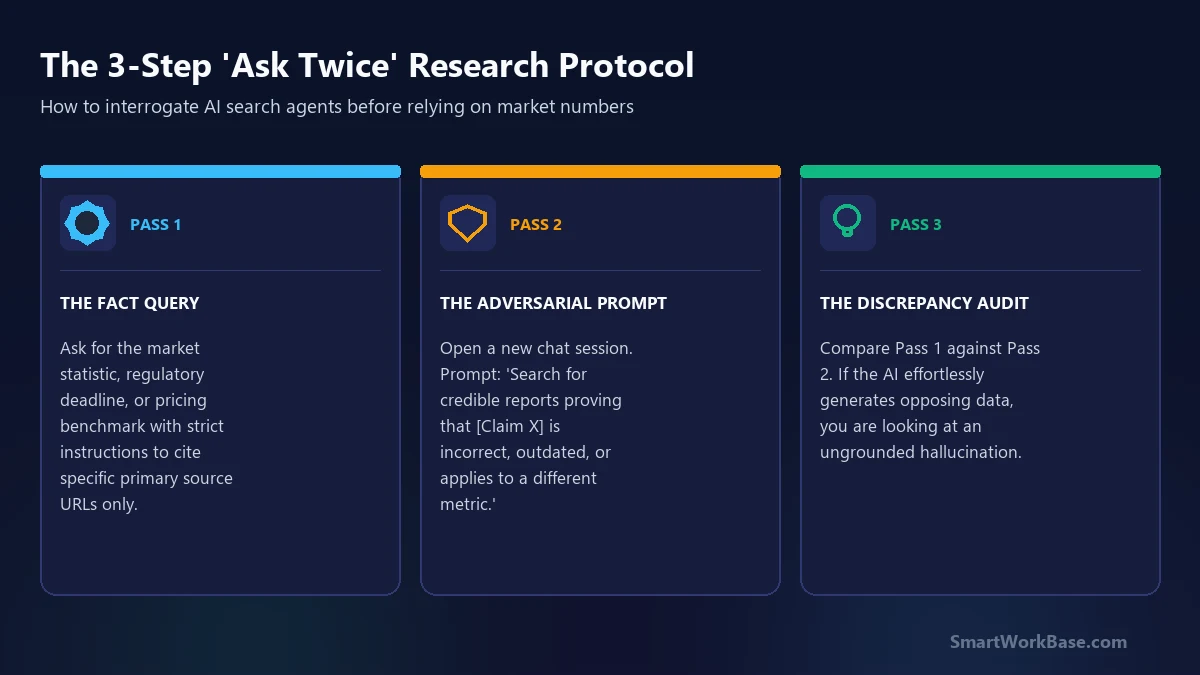
The protocol runs in three quick passes:
- Pass 1 (The Baseline Query): Run your initial market inquiry, requiring specific primary source URLs and numerical data.
- Pass 2 (The Adversarial Challenge): Open a clean session. Ask the exact opposite: “Find industry reports showing that [Claim X] is inaccurate, outdated, or contradicted by alternative market indices.”
- Pass 3 (The Discrepancy Audit): Compare Pass 1 and Pass 2. If the AI easily generates an equally confident response proving itself wrong, the metric is unstable and you must open the primary source PDF directly.
This is the same defensive principle behind the Two-Path Total Check for spreadsheets: never trust a single calculation when an independent route can verify it in 30 seconds.
The adversarial prompt template I keep pinned
When you need to verify a critical market statistic before a board presentation or supplier negotiation, use this prompt to run Pass 2:
Copy and paste this into a fresh AI search session immediately following your primary inquiry:
Where AI search tools genuinely excel
Despite the numerical blind spots, AI search engines remain an indispensable part of my workflow. They are extraordinarily effective when you use them for qualitative discovery rather than quantitative proof:
- Landscape Mapping: Discovering all tier-2 suppliers operating within a specific geographic cluster.
- Regulatory Taxonomy: Finding the exact legal name of an emerging EU environmental directive before diving into the legal text.
- Initial Orientation: Getting up to speed on an unfamiliar manufacturing process in five minutes before an executive briefing.
As I noted in my piece on the clauses AI misses in contracts, tools are magnificent accelerators for discovery, but validation remains your professional signature. Explore our AI Tool Finder and download our Free AI Prompt Cheat Sheet to build verified research workflows that protect your operational credibility.